Law Firm Case Management System
Legal Case Management
Overview
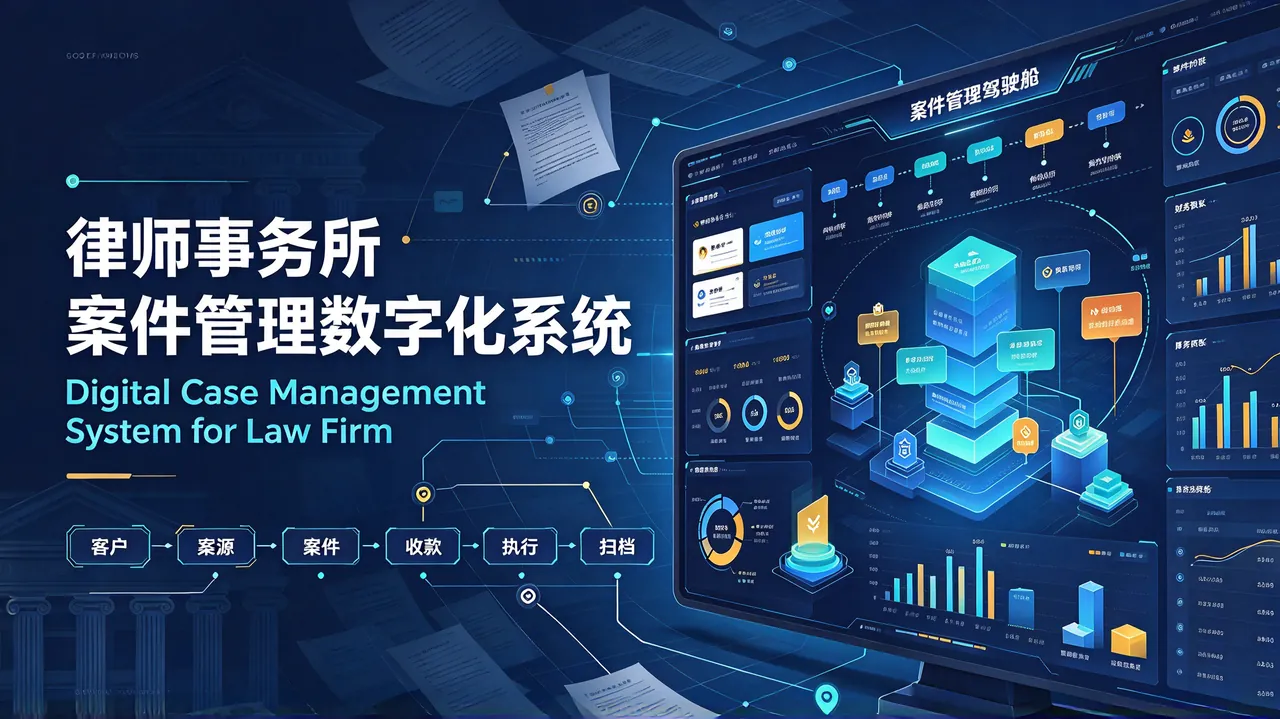
I led a case-management digitization project for a large law firm (~200 people): turning information that relied on manual work and WeCom coordination and was scattered everywhere into one unified, structured, traceable case-management system. I owned requirement analysis, business modeling, product design, technology selection, POC, and partial system development end to end.
The Challenge
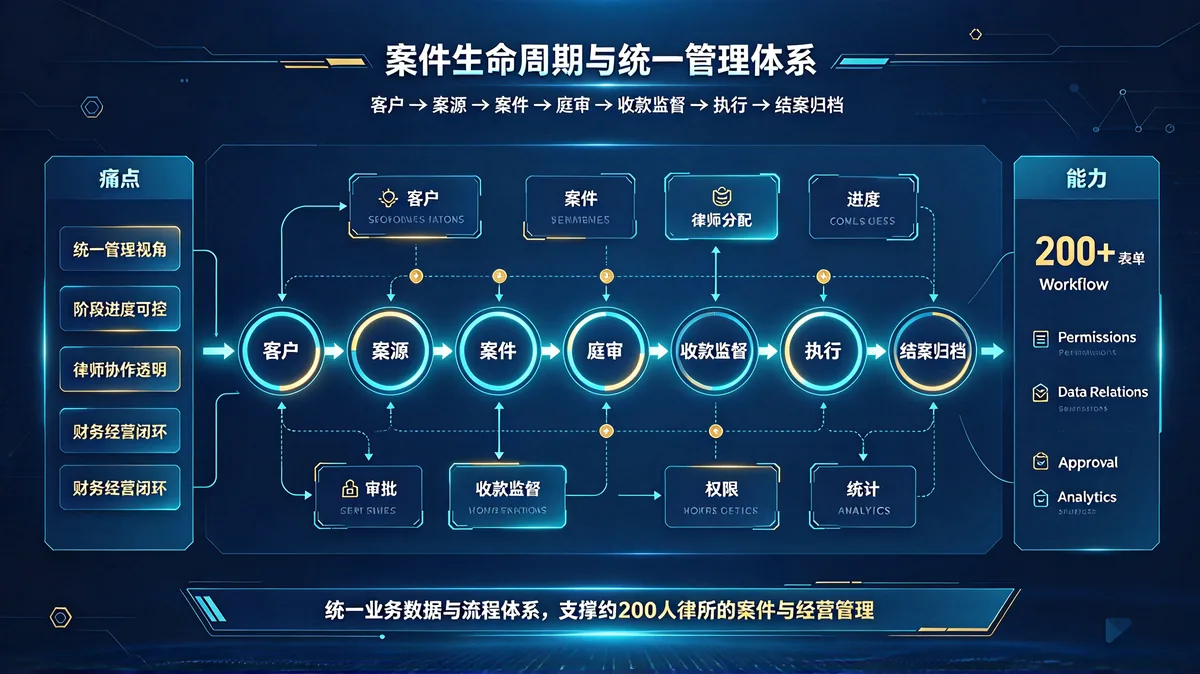
The firm had about 200 people and growing caseload, with four pain points: ① too many cases and no unified view (who owns it / what stage / next step / which are at risk); ② long case lifecycles (intake → filing → trial → mediation → execution → closure) tracked by manual reporting, hard to control; ③ opaque information between lawyers, collaboration by repeated communication; ④ cases disconnected from finance (client / contract / collection / disbursement / revenue / receipt), leaving management without a full operating view.
Solution
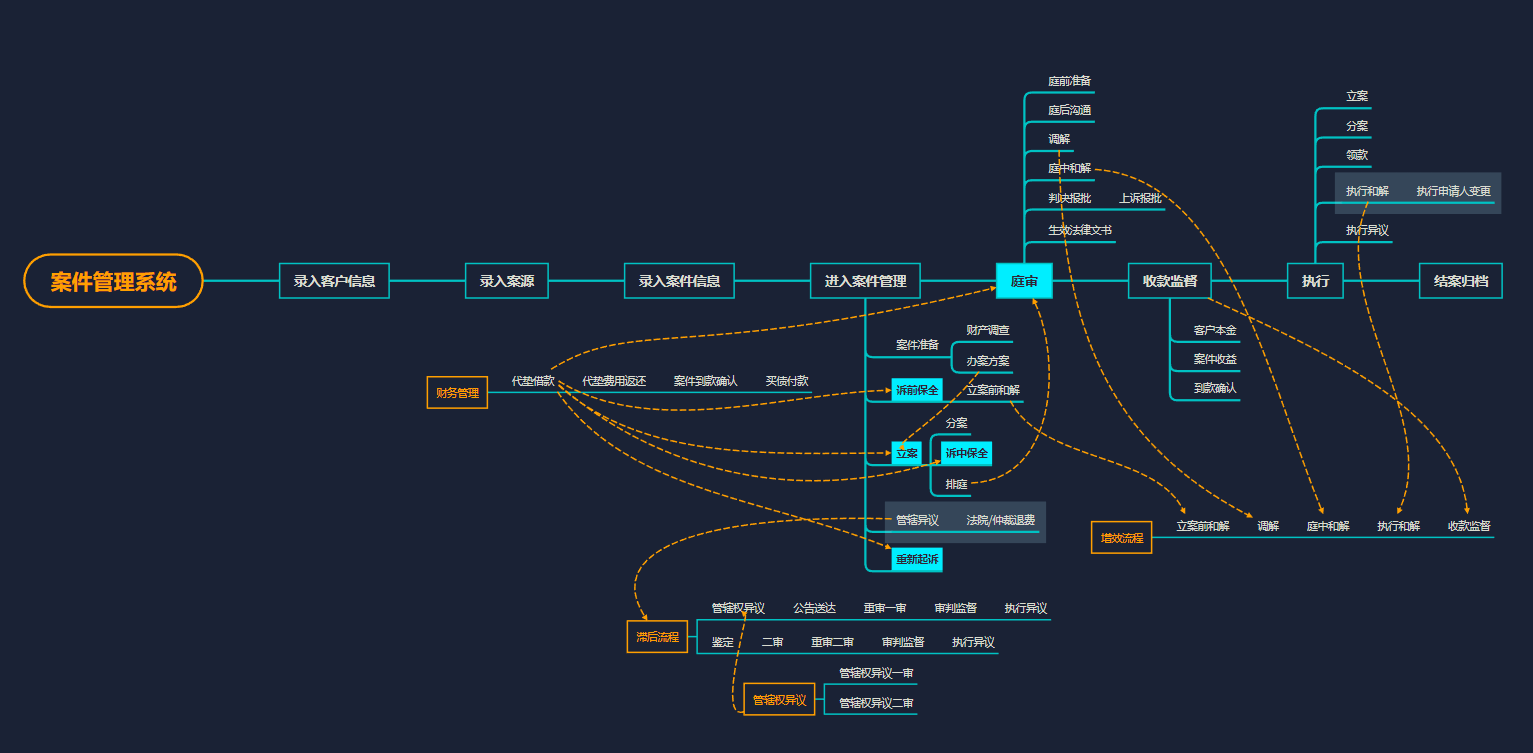
I built a unified business-data and process system around the case lifecycle: unified case / client / source, lawyer assignment, progress, approval, permissions, and statistics, with finance and collection oversight designed in. The plan covered 200+ forms across 9 modules (client / source / case / lawyer assignment / progress / approval / finance-collection oversight / permissions / statistics). Main flow: client → source → case → trial → collection oversight → execution → archived closure; surrounded by associated flows for trial, execution, collection, and finance.
Case Lifecycle
Implementation
I started with a ~1-week POC validating core scenarios (case / client / lawyer assignment / progress / approval / permissions / statistics), then moved into partial formal development. Technology selection compared low-code vs traditional OA vs custom development: traditional cycles and cost exceeded the client’s expectations, and their deep-customization needs were limited, so low-code was chosen as a phased architecture decision — lowering cost and speeding delivery while keeping configuration flexibility and room to move to custom later.
Key Capabilities
- ›
ToB Requirement Analysis
Quickly grasping business rules in an unfamiliar professional domain.
- ›
Complex Business Modeling
Turning long-cycle, cross-role processes into structured models.
- ›
Low-Code Architecture
Choosing a phased fit between cost and flexibility.
- ›
Technology Selection
Comparing low-code / OA / custom by real need.
- ›
POC / Project Management
Validating core scenarios fast before scaling up.
Deliverables
A complete structured design of business process and case lifecycle, a 9-module product model, a ~1-week POC (core scenarios validated), and partial system development; the low-code route’s fit was verified.
Takeaway
For complex-business digitization, the key is usually to clarify the business rules first, then pick the right technology and validate at lowest cost.
Tech Stack
Platform
Capabilities
Next Step
If you face a professional business that is “complex, cross-department, and finance-linked,” and need someone to clarify the business first, then choose the right tech and validate at lowest cost.
Contact